
Introduction
At some point between the third agency onboarding call and the fifth Slack thread about which version of the logo is current, a VP of Digital at a large enterprise realizes something uncomfortable: the brand portfolio has become a full time coordination job that produces inconsistent output at enormous scale and costs.
The pattern is consistent across industries:
- A financial services holding company runs six brand sites, each built independently, each governed by different people, each drifting further from the parent brand with every update cycle.
- A CPG conglomerate manages forty regional and brand domains with no shared infrastructure, no consolidated performance view, and a content duplication problem that compounds every quarter.
- A pharma group maintains product, corporate, and HCP facing properties carrying regulatory obligations, all sitting on incompatible platforms with no unified publishing workflow.
The operational drag is measurable. Enterprise scale websites spend between $30,000 and $60,000 annually per web property on maintenance alone. Multiply that across ten brand sites and you have $600,000 in annual overhead before a single piece of content is created.
Consolidate that portfolio onto shared infrastructure and the number drops substantially, not because the work disappears, but because it stops being repeated from scratch for every brand.
The revenue case is equally concrete. Consistent brand presentation across all platforms can boost revenue by 23%, while inconsistent branding can reduce it by the same margin. For a $1B enterprise, the swing between a unified and fragmented portfolio is a P&L question.
85% of businesses have brand guidelines. Only 30% use them regularly. The gap between intention and execution is almost entirely a systems problem. This guide covers what the right system looks like.

How Brand Portfolios Break Down
The failure modes are consistent enough to be predictable. They compound each other, which is why portfolios that start breaking tend to accelerate rather than stabilize on their own.
Brand drift
When sites are built independently, by different agencies, at different times, on incompatible platforms, visual and tonal divergence is the default output. A redesign on one brand site does not cascade to the others. A new campaign framework gets interpreted differently by every team that touches it. Without a shared design framework, fragmentation is the outcome. Over time the portfolio reads as a collection of unrelated businesses, which commercially is what it starts to become.
Duplicated overhead
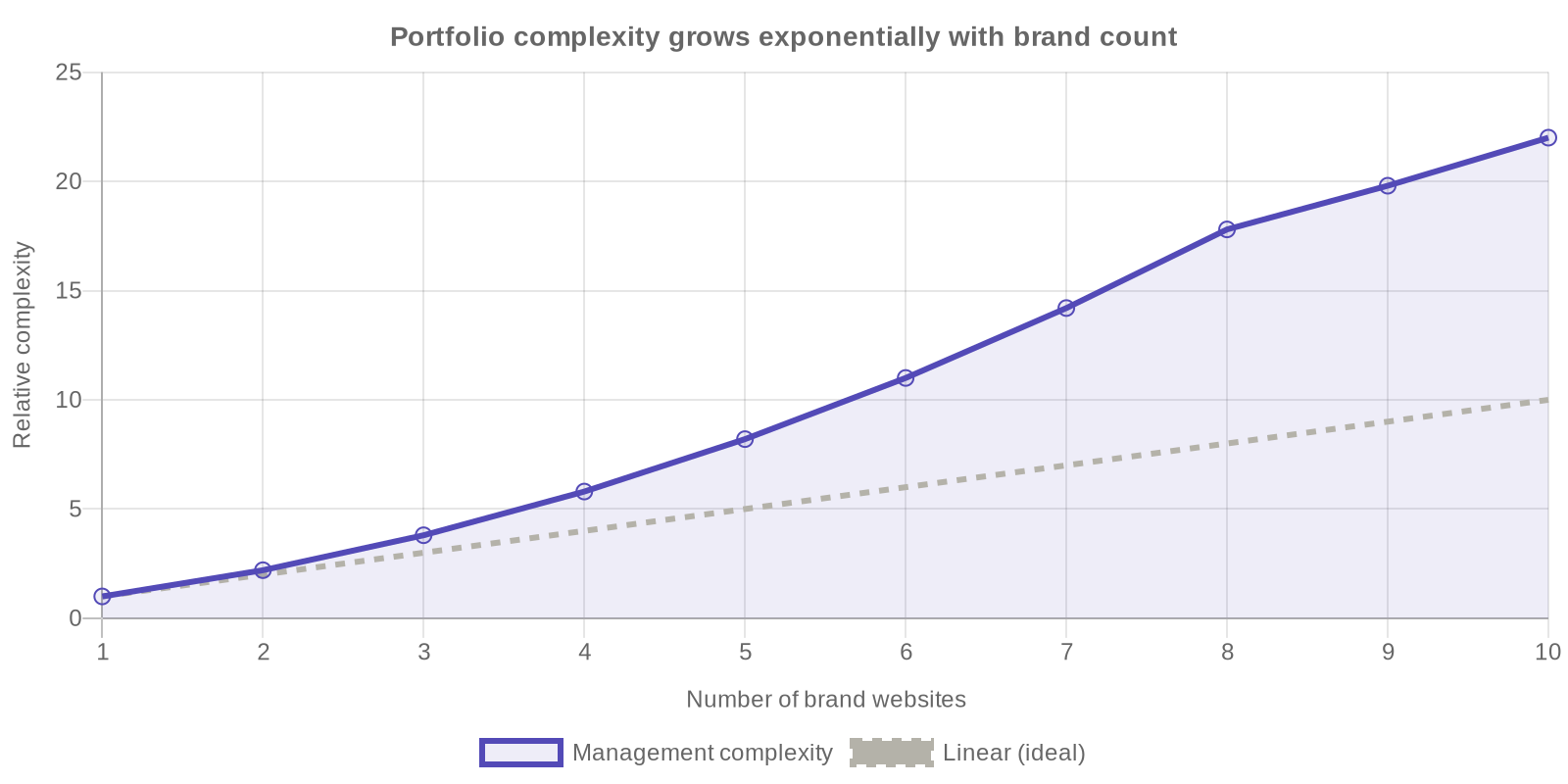
Every shared asset, legal disclaimers, product specifications, component libraries, navigation patterns, gets rebuilt per brand site. Every platform update gets applied independently, or not applied at all. Adding a second site doubles complexity. By the fifth property, teams are managing duplicated effort, inconsistent execution, and fragmented insights simultaneously. The only way to scale a fragmented portfolio is to add headcount, and headcount scales linearly while complexity scales exponentially.
Scattered SEO and AI authority
Brand sites on separate domains with no cross-linking strategy keep domain authority siloed. Content that could compound across a portfolio instead cannibalizes it. With AI search platforms like ChatGPT, Perplexity, and Google AI Overviews shaping how buyers discover solutions, fragmented brand presence means AI models struggle to form a coherent representation of who you are and what you offer. Scattered brands get scattered citations. Unified brands get cited as authorities.
Governance without enforcement
The central tension in multi-brand website management is between the need for centralized policy and control, and the reality that brand teams need to create and update content rapidly and continuously. Without platform enforced governance, brand standards become suggestions.
With overly centralized governance, brand teams route around IT and shadow CMS instances proliferate. Both failure modes are real, and they require architecture to solve, not process alone.
What Unified Actually Means
Unified multi-brand website management is a single operational layer governing shared infrastructure, design systems, CMS, publishing workflows, and performance data, while individual brands retain full creative and editorial independence within it.
Two failure modes bracket the target zone:
- Over-centralize and brand teams route around IT to hit deadlines, producing shadow CMS instances and agency-built one-offs that live permanently outside your governance model.
- Over-decentralize and the portfolio fragments by default. The architecture has to solve for both simultaneously.
The right approach decouples frontend content management from backend technical administration. It creates a composable content ecosystem where businesses can extend creative autonomy to individual brand teams while retaining centralized control of the wider infrastructure.
Three portfolio structures show up most often across enterprise clients, each with a different primary constraint:
- The holding company model. A parent brand with independent sub-brands operating in separate markets. Danone owns Activia, Evian, and Alpro. BMW owns MINI and Rolls-Royce. Each brand needs a genuinely distinct digital identity. The infrastructure is shared. The market-facing experience is not. The governance layer here is the most demanding because brand isolation is commercially non-negotiable.
- The regional expansion model. One brand, many geographies, each requiring localized content, regulatory compliance, and market-specific experiences. The content model is simpler but compliance overhead is highest. Pharma and financial services enterprises typically operate this way.
- The acquisition integration model. The most common starting point for enterprises working with Anyday. M&A driven growth has produced a collection of disconnected web properties, each on its own stack, each managed by a different team or agency. The immediate priority is operational consolidation. Design and editorial alignment come after the infrastructure is unified.
The Architecture That Makes it Work
Four layers need to be designed together. They are interdependent. Get any one wrong and the others compensate poorly.
Layer 1: Shared content infrastructure
A headless CMS sits at the center. Content is authored once in a structured, brand-agnostic format and delivered via API to each brand's frontend. Shared content types, legal disclaimers, product specifications, regulatory copy, live in the CMS once and get pulled into whichever brand sites need them.
Brand-specific content lives in its own namespace but runs on the same infrastructure. This allows businesses to extend creative autonomy to individual brand content teams while retaining centralized control of the wider content ecosystem.
Layer 2: Design system with brand tokens
One component library, built on design tokens that resolve to brand-specific values at render time. The button component is defined once. Its color, radius, and typography render differently depending on which brand token set is active.
Every brand looks distinct. The codebase stays unified. Updates to the component library propagate to all brand sites simultaneously without touching individual brand configurations.
Layer 3: Unified publishing and governance
Role-based access controls who can publish what, to which brand, in which markets. Brand editors create and publish within their domain without raising a ticket. Cross-brand content, campaign assets, regulatory copy, executive messaging, requires central approval before it goes live.
Corporate service groups own web architecture. Local business units own content and organization within that structure. The platform enforces the split rather than relying on people to remember it.
Layer 4: Consolidated performance intelligence
Cross-portfolio analytics surfaces what a per-site view cannot: which content types perform across brands, where SEO authority is compounding, which brand sites are dragging portfolio performance.
This data drives decisions about where to invest content effort at the portfolio level rather than the site level.
The Tech Stack Choices That Determine Whether This Works
The architecture above is platform-agnostic in principle. The stack choices you make determine whether you can execute it in practice. Three decisions matter most.
The CMS
Legacy monolithic platforms, WordPress Multisite, Drupal, Sitecore, and Adobe Experience Manager were not designed for multi-brand portfolio management at enterprise scale.
WordPress Multisite is the most common offender: it approximates a shared infrastructure but ties brand sites together at the database level, meaning a plugin conflict or security vulnerability on one site creates risk across the entire network.
A single WordPress update becomes a coordinated deployment event across every brand. Drupal and Sitecore share similar constraints; governance is bolted on rather than native, and the multisite configurations that seem like a solution tend to create new dependencies that compound over time.
Headless CMS platforms built around structured content and API first delivery handle multi-brand architectures natively because content models are brand-agnostic by design. Sanity is the clearest example of this done well at enterprise scale.
The frontend framework
A shared component library only delivers value if the frontend can consume it consistently across brands.
Next.js, with its per-route rendering control and strong TypeScript support, is the framework best suited to multi-brand architectures at enterprise scale. Each brand route can carry its own token set and layout configuration while sharing the vast majority of the codebase.
The deployment infrastructure
Vercel's per-brand deployment configuration means each brand site can be updated, rolled back, and tested independently without touching the others. This is the operational safety net that makes shared infrastructure viable at scale. One bad deploy to Brand A does not take down Brand B through F.

How to Assess Where You Stand
Before designing a target architecture, it is worth being honest about the current state. These five questions surface the gaps that matter most.
How many CMS platforms does your portfolio run on?
One is the target. More than three and you have a consolidation project before you have an architecture project.
WordPress Multisite installations count as one platform but often mask the same fragmentation problem in a different form; shared databases and plugin dependencies create coupling that makes independent brand updates nearly impossible.
How long does it take to propagate a brand guideline update across your portfolio?
Days is acceptable. Weeks is a problem. Months means your brand guidelines are suggestions, not standards.
How is cross-portfolio performance reported?
If the answer is that each site has its own analytics and you aggregate manually, your performance data is too slow and too fragmented to drive portfolio-level decisions.
Who has the authority to publish to each brand site, and is that documented and enforced by the platform?
If you have to ask someone to find out, you have institutional memory rather than a governance model.
When was the last time a brand editor updated a page without raising a development ticket?
If brand teams cannot self-serve within defined guardrails, your architecture is making IT a bottleneck and your brands are finding ways around it.
The Transition Sequence
Enterprises that try to unify everything simultaneously, CMS migration, design system rebuild, and governance restructure all at once, almost always stall. The sequence matters.
Phase one is infrastructure consolidation.
Get all brand sites onto a shared CMS and deployment infrastructure. This is the highest-leverage step and the prerequisite for everything else.
For enterprises coming off WordPress Multisite, this phase also means untangling shared database dependencies and auditing plugin conflicts before migrating content.
Design and editorial workflows can stay as-is during this phase. The goal is operational unity, not creative uniformity.
Phase two is design system alignment.
Build the shared component library with brand token support. Migrate brand sites to it incrementally, starting with the highest-traffic pages. This is where brand identity gets formally defined and codified rather than living in agency mood boards and Figma files that nobody enforces.
Phase three is governance implementation.
Define roles, permissions, and approval workflows in the platform. Document them. Train brand teams on them. This phase is as much change management as technology. The systems only work if the people operating them understand why the structure exists.
Phase four is performance compounding.
Cross portfolio analytics in place, editorial calendar aligned across brands, SEO strategy designed at the portfolio level. This is where the investment returns disproportionately. Shared authority compounds.
Shared content reduces production costs. Brand sites start reinforcing each other rather than operating in isolation.

The Anyday Approach
Anyday builds unified WebOps platforms for multi-brand enterprises, specifically the architecture described above.
The stack is Next.js for the frontend, Sanity for the CMS, and Vercel for deployment. Each layer is configured to support multi-brand operations natively: Sanity's content model handles brand namespacing, Next.js handles per-brand token sets and routing, and Vercel handles per-brand deployment and preview environments.
Engagements typically start with an audit of the current portfolio, how many platforms, how much technical debt, what the governance model currently is, and move through the four phases above.
Many enterprises arriving at Anyday are running WordPress Multisite or a collection of independent WordPress installs across their brand portfolio.
In both cases the consolidation path is well established. Most enterprises are on shared infrastructure within twelve weeks and operating on a unified editorial model within six months.
If you are managing more than two brand websites and feeling the operational drag, it is worth a conversation.
.svg)
